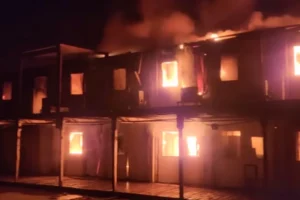
Tensions in the Middle East have sharply increased after Ayatollah Ali Khamenei, the Supreme Leader of Iran, was killed during a joint air campaign carried out by Israel and the United States. Israeli officials say the operation followed international law and had been planned months in advance.
The strike took place in the first hours of a military campaign that began on Saturday. The attack has since triggered a wider regional conflict, with missile strikes, retaliatory attacks, and growing tensions across the Middle East.
Israel Says Strike Followed International Law
Israel has defended the killing of Khamenei by arguing that he was a legitimate military target during wartime.
According to Israeli military spokesperson Nadav Shoshani, the strike complied with international law governing armed conflict. He said that military commanders directing armed forces during a war can legally be targeted.
Shoshani explained that as Iran’s Supreme Leader, Khamenei also served as the commander-in-chief of Iran’s armed forces and had the final authority over the country’s military operations.
Israeli officials claim he played a key role in directing attacks against Israel and supporting groups hostile to the country. They argue that removing him weakened Iran’s ability to plan and coordinate military operations.
Assassination Planned Months Earlier
New details about the operation were revealed by Israel’s Defence Minister Israel Katz, who said the decision to eliminate Khamenei was taken months before the strike.
Katz said a high-level meeting was held in November with Israeli Prime Minister Benjamin Netanyahu and other senior officials. During that meeting, Netanyahu reportedly set the goal of targeting Khamenei.
The operation was originally planned to take place around mid-2026. However, the timeline was later moved forward.
According to Katz, the plan was shared with the United States and was accelerated around January after protests broke out in Iran. Israeli leaders feared that pressure on Iran’s government could lead to military action against Israeli or American targets in the region.
Strike Sparks Regional Conflict
The airstrike that killed Khamenei marked the first known case in which a country’s top ruler was killed in an air attack.
The operation immediately triggered a strong response from Iran. Iranian forces launched waves of missile attacks against Israel and targeted locations linked to the United States across the Middle East.
The fighting quickly spread beyond the two countries. Iran-linked groups and regional allies became involved in the conflict, raising fears of a broader regional war.
Israel also carried out strikes against Hezbollah, an Iran-backed group based in Lebanon, further increasing tensions in the region.
Civilian Deaths Reported
Iranian media reported that several members of Khamenei’s family were also killed in the strike. Reports said his wife, son-in-law, and two grandchildren who were minors died during the attack.
These reports have raised concerns about civilian casualties and the humanitarian impact of the operation.
Israel Cites Nuclear Threat
Israeli leaders say the military campaign was necessary to remove what they describe as an existential threat posed by Iran.
According to Israeli officials, Iran had been rebuilding parts of its nuclear weapons programme in a new underground facility while also expanding its ballistic missile capabilities.
Israel says its goal is to stop these developments and reduce Iran’s military power. Some officials have also suggested that the broader objective could include political change inside Iran.
However, Iran’s leadership has shown no sign of stepping down despite the escalation.
Growing Uncertainty in the Region
As the conflict enters its first week, military strikes and counterattacks continue across several countries in the Middle East.
With Iran, Israel, and their allies exchanging attacks, analysts warn that the situation could develop into a prolonged regional conflict if diplomatic efforts fail to reduce tensions.
The killing of Khamenei has already become one of the most dramatic events in the recent history of the region, and its consequences are likely to shape Middle East politics for years to come.

Andy Roberts is a seasoned journalist with nearly 9 years experience. While studying journalism at Ryerson, Annie found a passion for finding engaging stories. As a contributor to White Pine Tribune, Annie mostly covers provincial and national developments..