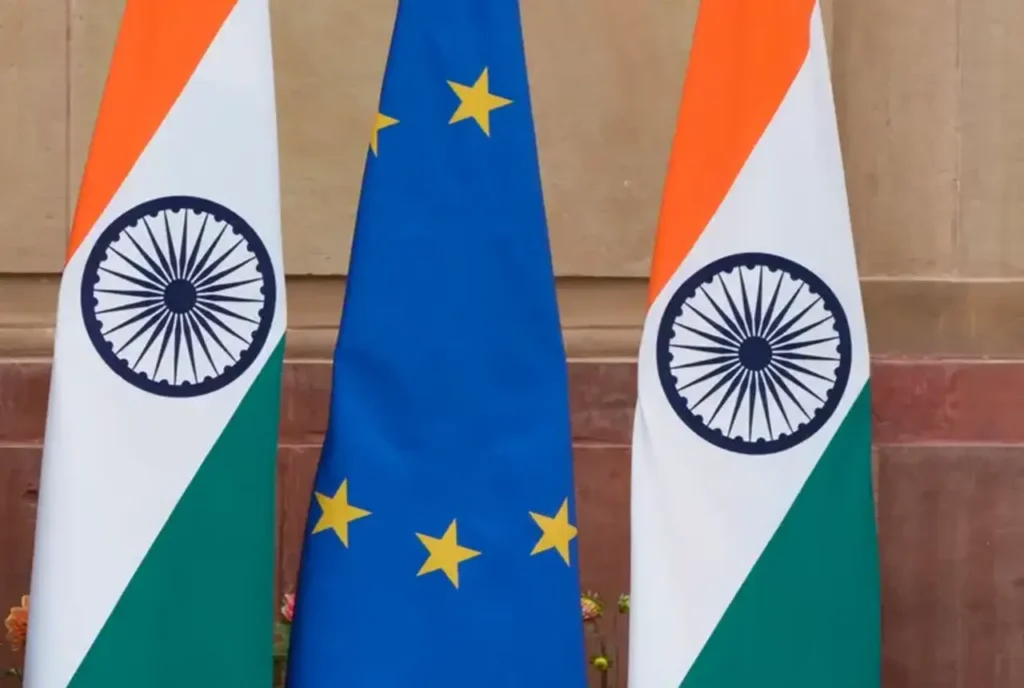
India and the European Union have announced a long-awaited free trade agreement, marking a major step in their economic and strategic partnership. The deal was revealed during a high-level summit in New Delhi, attended by Prime Minister Narendra Modi, European Commission President Ursula von der Leyen, and European Council President António Costa.
Both sides described the agreement as historic, coming after nearly two decades of difficult negotiations. The pact is expected to reduce tariffs, expand market access, and strengthen supply chains between two of the world’s largest democratic economies.
A Deal Covering a Quarter of the Global Economy
Together, India and EU represent nearly 25% of global GDP and a combined market of about two billion people. Leaders on both sides said the agreement would allow smoother trade in goods and services while supporting long-term investment.
European Commission President Ursula von der Leyen called it “the mother of all deals,” while Prime Minister Modi said it would help Indian farmers, small businesses, manufacturers, and service providers gain easier access to European markets.
Major Tariff Cuts and Market Access
Under the agreement, tariffs on most European exports to India will be reduced in stages. This includes chemicals, machinery, electrical equipment, aircraft, and spacecraft. Import duties on cars, currently as high as 110%, will be cut to 10% under a fixed quota system.
At the same time, Indian businesses will gain better access to EU markets, especially in sectors such as IT services, pharmaceuticals, textiles, and manufacturing. Some sensitive farm sectors, including dairy and sugar, have been kept outside the deal.
Why the Timing Matters
The trade pact comes at a time of rising global uncertainty. Both India and EU are facing economic pressure from the United States, where President Donald Trump has taken a tough stance on tariffs.
India has been dealing with high US tariffs on some exports, while the EU has recently faced trade threats linked to disagreements with Washington. European leaders said the agreement sends a clear signal that India and the EU believe in cooperation and trade agreements, not tariff wars.
More Than Just Trade
The deal goes beyond economics. India and EU are also strengthening cooperation in areas such as security, defence, climate action, clean energy, and technology.
Discussions are ongoing on a broader security and defence partnership, including maritime security, cyber threats, and defence supply chains. Both sides also see the agreement as supporting long-term stability and trusted global partnerships.
Strong Symbolism at Republic Day
The announcement gained added importance as EU leaders were the chief guests at India’s Republic Day celebrations. Diplomatic observers say this reflects Europe’s growing focus on India as a key global partner, not just a trade market.
Leaders said the agreement shows shared values and a common commitment to open, rules-based global trade.
Next Steps
The trade deal will now go through legal review and approval by the European Parliament and EU member states. The formal signing is expected later this year.
Once implemented, the agreement is expected to reshape trade ties between India and Europe and set a strong example at a time when protectionism is rising worldwide.

Mayur is a part time journalist with about 2 years experience. While working in the field of healthcare, Mayur found a passion for finding engaging stories. As a contributor to White Pine Tribune, Mayur mostly covers International Politics and Life Sciences Related Stories